
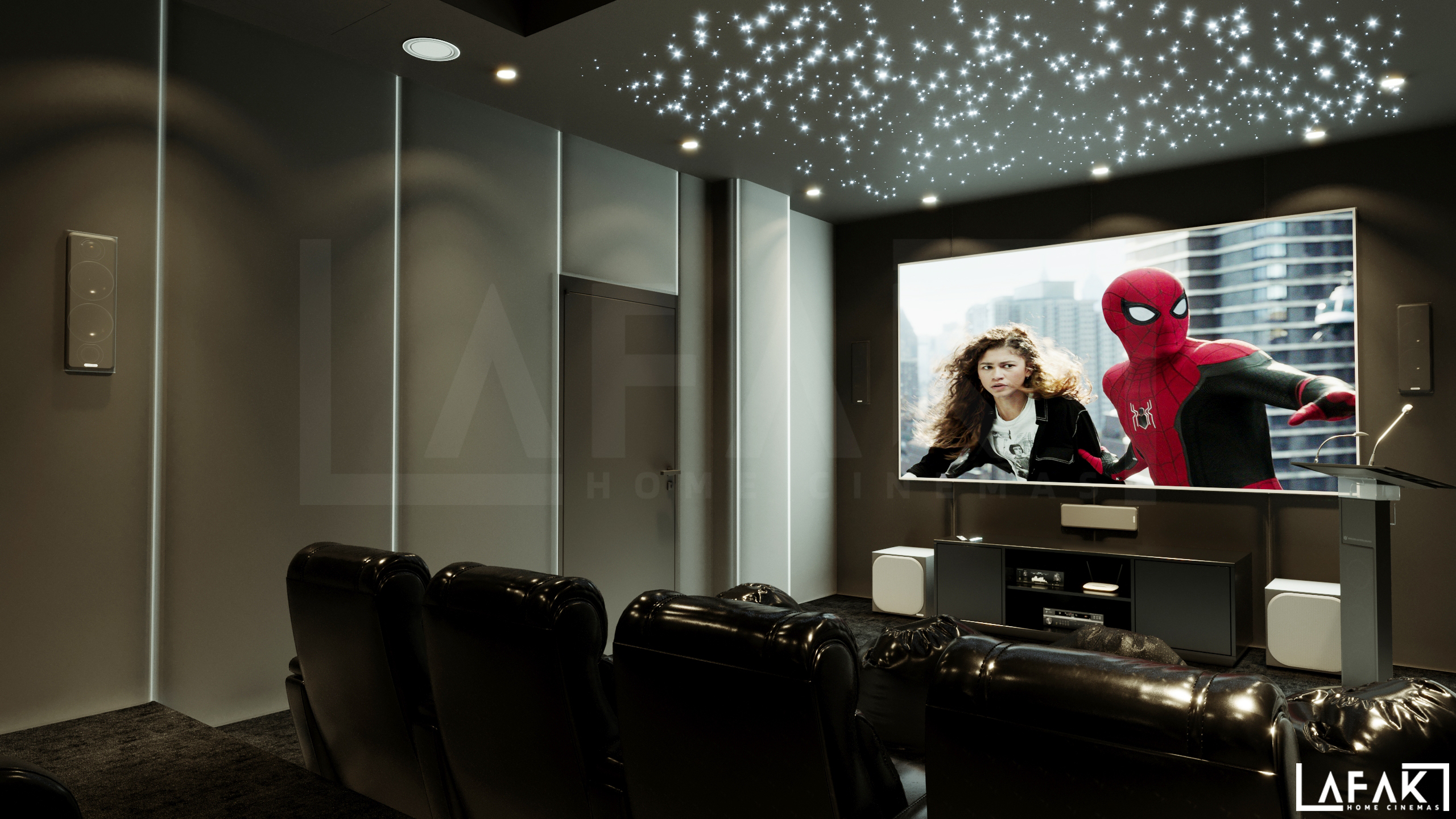
Fibre Optic Lighting is becoming a popular choice for luxury interiors in 2026. Instead of using only traditional ceiling fixtures, homeowners and designers are finding creative ways to use tiny points of light to add mood, depth, and character to a room.
Think about walking into a home cinema with a soft starry ceiling above you, or a lounge where subtle points of light highlight a feature wall. The lighting doesn’t need to be bright to make an impression. Sometimes, a few carefully placed lights can do more than a room full of fixtures.
If you’re planning a luxury home cinema or specialised lighting project, Afak Home Cinemas works with homeowners and designers across Dubai and the UAE to create customised cinema and lighting solutions.
So, what are the big lighting trends for 2026? Let’s look at some ideas worth considering.
1. Starry Ceilings Are Getting More Realistic
Star ceilings have been popular in home cinemas for years, but they’re becoming much more detailed.
Instead of placing identical points of light in a regular pattern, designers are creating ceilings that look more like a real night sky.
Different fibre sizes can create stars with different levels of brightness. Some areas can have more stars, while other sections remain darker.
This gives the ceiling a natural look instead of making it feel like a repeated design.
A custom star ceiling can work particularly well in:
- Home cinemas
- Bedrooms
- Gaming rooms
- Private lounges
- Entertainment rooms
- Luxury majlis areas
The trick is not to make every point of light equally bright. A real night sky isn’t perfectly even, and your ceiling doesn’t need to be either.
2. Fibre Optic Lighting Is Moving Beyond Star Ceilings
When people hear about fibre optics, they often think about stars on a cinema ceiling.
That’s only one option.
Designers are now using fibre optics in wall panels, decorative features, ceilings, furniture details, and other areas where a small glow can add something special.
For example, imagine a dark feature wall with tiny points of light hidden within the design. During the day, the wall looks clean and simple. At night, the small lights become part of the room’s character.
This works especially well when the lighting isn’t trying to become the main attraction.
Some creative applications include:
- Decorative wall panels
- Curved ceiling details
- Feature walls
- Joinery
- Backlit fabric panels
- Entertainment spaces
- Staircase features
This gives designers more freedom to use fibre optic ceiling lights as part of a larger lighting plan instead of treating them as a standalone feature.
3. Natural Patterns Are Replacing Perfect Rows
Perfectly spaced lights may look neat, but they don’t always look natural.
One of the more interesting trends is the use of random or semi-random patterns. The lights can be spread unevenly, with some areas having clusters of brighter points and other areas having fewer.
This is especially useful when creating a realistic star ceiling.
A designer might use:
- Small fibres for distant stars
- Larger fibres for brighter stars
- Different spacing for a natural effect
- Gentle twinkling in selected areas
- Darker sections to create depth
The finished ceiling can feel much closer to looking at an actual night sky.
| Older Approach | 2026 Approach |
| Regular spacing | Random, natural spacing |
| Similar brightness | Different brightness levels |
| Simple pattern | Custom star layout |
| Mostly static | Optional subtle effects |
| Mainly ceiling-focused | Ceiling and feature integration |
It’s a small design change that can make a big visual difference.
4. Smart Lighting Controls Are Becoming Normal
Luxury homes are increasingly using smart controls for lighting.
Instead of having one switch for everything, homeowners can create different lighting scenes for different situations.
A home cinema is a good example.
| Scene | Possible Lighting |
| Movie | Main lights dimmed, stars on |
| Break | Soft ambient lighting |
| Cleaning | Bright room lighting |
| Relax | Low-level lighting |
| Guests | Feature and ambient lights |
This is where smart lighting design can make a room more flexible.
The lighting doesn’t always need to be connected to one single control system. The exact setup depends on the equipment and project requirements, but the goal is simple: make it easy to create the right mood without complicated controls.
5. Home Cinemas Are Still a Perfect Match
Home cinemas are one of the best spaces for fibre optic lighting.
Why? Because cinema rooms are already designed around controlled light.
A dark ceiling gives the tiny points of light a clean background. When the main lights are dimmed, the stars can create a soft atmosphere without competing with the projector screen.
But there’s a balance to find.
Too much brightness can become distracting. Too many effects can make the room feel busy. Good cinema lighting should support the experience rather than take attention away from the movie.
A luxury cinema might combine:
- Fibre optic star lighting
- Acoustic wall panels
- A projector and screen
- Dolby Atmos speakers
- Cinema recliners
- Carpeted flooring
- Hidden LED lighting
- Dark interior finishes
Each part has a purpose, and the lighting needs to work with all of them.
6. Small Lighting Details Can Have a Big Effect
Not every project needs hundreds of lights.
Sometimes, a few carefully placed points are enough.
Small fibre optic details can be added to decorative panels, ceilings, furniture, or architectural features. They can create a gentle glow that’s only noticeable when the room becomes darker.
This approach is useful for homeowners who want something different without making the room look overly dramatic.
For example, a few tiny points around a curved ceiling feature can create a subtle border. In another room, fibres inside a decorative wall panel could create a soft pattern.
These details can be particularly effective in modern luxury interior lighting because they add another layer without taking up physical space.
7. Custom Designs Are More Popular Than Ready-Made Patterns
A luxury home should feel personal.
That’s one reason custom lighting layouts are becoming more popular.
A bedroom, cinema, lounge, and gaming room don’t need the same lighting pattern. The size, ceiling height, furniture arrangement, and purpose of each space can change the design.
Before deciding on the pattern, it’s useful to consider:
- How big is the room?
- How high is the ceiling?
- Where will people sit?
- What other lights will be installed?
- Will speakers or HVAC grilles share the ceiling?
- Do you want a twinkle effect?
- How will the system be controlled?
- How will maintenance be handled?
These details are easy to overlook when you’re focused only on how the finished ceiling will look.
8. Lighting Needs to Work With the Interior
One of the biggest changes in luxury projects is that lighting is being considered earlier in the design process.
That’s a good thing.
A ceiling might contain speakers, air-conditioning grilles, sensors, access panels, projectors, and decorative features. If the fibre layout is designed separately, these elements can end up competing for space.
For a home cinema, for example, the position of Dolby Atmos speakers needs to be considered alongside the star ceiling.
The same applies to wall panels and joinery.
A coordinated design helps the finished space look intentional rather than like several different systems were added at different times.
This is also where luxury villa lighting needs careful planning. Large villas often have several rooms with different lighting requirements, so one standard layout won’t always work.
9. Softer Lighting Is Taking Centre Stage
Bright lighting isn’t always the answer for a luxury interior.
Many homeowners are choosing softer, calmer lighting that can change depending on what they’re doing.
A kitchen may need bright task lighting. A home office needs practical illumination. A bedroom might need something much softer.
A cinema or lounge can use low-level lighting to create a relaxed atmosphere.
Fibre optics fit nicely into this style because they can add visual interest without flooding the room with light.
The same idea applies to smart lighting design. Instead of keeping every light at full brightness, homeowners can create scenes that match different times and activities.
What Should You Check Before Installing Fibre Optics?
A beautiful lighting concept still needs good planning.
Before starting, discuss these points with your designer or installer:
| What to Check | Why It Matters |
| Fibre quantity | Determines how dense the effect will look |
| Fibre sizes | Creates different star sizes and brightness |
| Light source location | Affects access and maintenance |
| Ceiling structure | Determines how installation can be done |
| Other ceiling services | Helps avoid clashes |
| Control system | Determines how scenes and effects work |
| Maintenance access | Makes future servicing easier |
| Interior finishes | Can affect how the light appears |
Planning these details early can save time and prevent changes later.
How Fibre Optic Lighting May Shape Luxury Interiors
The interesting thing about this technology is that it doesn’t have to look futuristic.
It can be extremely subtle.
A few points in a ceiling can create a calm atmosphere. A detailed star pattern can transform a home cinema. Small fibres in a wall feature can give a modern room an extra layer of detail.
That’s why designers have so many ways to work with it.
The focus is shifting from simply asking, “Where can we put lights?” to asking, “What should this room feel like?”
And that’s a much more useful question.
Final Thoughts
Fibre Optic Lighting in 2026 is moving toward more natural patterns, customised designs, smart controls, and subtle architectural details.
Star ceilings are still a favourite, especially in home cinemas, but designers are finding new ways to bring tiny points of light into walls, joinery, lounges, bedrooms, and luxury villas.
The best designs don’t need to be the brightest or most complicated. They simply need to suit the room and the people using it.